
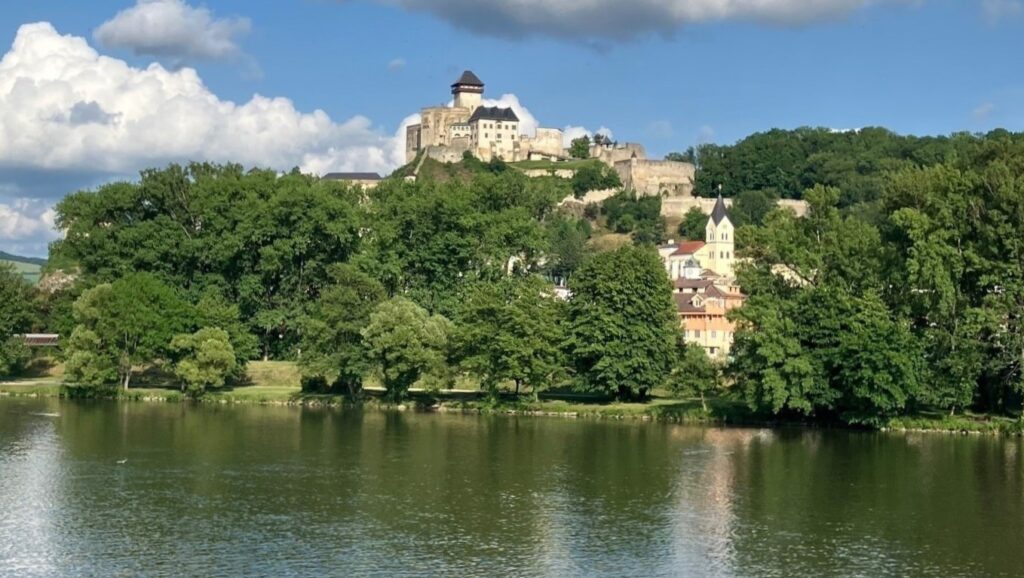
There are almost 200 castles in Slovakia, so it’s not surprising that the capital city is dominated by Bratislava Castle, once the residence of Hungarian monarchs. Slovakia was part of the Hungarian state for one thousand years until the formation of Czechoslovakia at the end of the first world war.
Bratislava has been the capital of the independent Slovak Republic since the “velvet divorce” in 1993. The city is located in the far southwest of Slovakia, set along the River Danube, close to the border with Austria and Hungary. Vienna Airport is just forty-five minutes’ drive from Bratislava, so it’s a convenient international gateway.
Today Bratislava is an attractive city with a medieval old town and a district of art nouveau and art deco buildings from the early twentieth century, plus a rather less attractive “new town” on the south of the river recalling the cold war era. It’s well worth going beyond Bratislava to discover the real Slovakia, where I found a fairy tale land of medieval towns and pretty villages, forests, rivers and castles. Then as I reached the mountains, I was invited to try some high adrenaline adventures.
I recommend a visit to Oravsky Hrad castle. It’s perched precariously like an “eagle’s nest” on a rock, high above the River Orava. One can travel to the castle on a wooden raft, a pleasant journey drifting downstream, controlled by two oarsmen dressed in traditional costume. Oravsky Hrad, like many Slovak castles, started as a medieval fortress and later became the home of noblemen and aristocrats. Each resident added to the castle, giving a rich mix of architectural styles. You might recognise the castle from many horror movies, the first being the classic “Nosferatu” filmed in 1922.
Slovakia follows the arch of the Carpathian Mountains, with the highest peaks being in the Tatra chain, close to the northern border with Poland. This is a paradise for adventure enthusiasts, with alpine and cross-country skiing, sledding and ice climbing during the winter; hiking, cycling and mountain biking during the summer.
One high adrenaline adventure was to attempt a “via ferrata”, which is a climbing route equipped with steel cables and ladders, allowing climbers to safely traverse steep terrain. Our guides explained the safety equipment. We used two carabiners to attach our harness to the cable on the rocky wall and then started climbing. The steeper sections of the climb were not always the most difficult. More challenging were the sections where we traversed over a seemingly flat rockface, holding onto the cable for dear life while desperately seeking footholds in the rock. Everyone made it safely to the summit, where we shared a fine sense of achievement. A thrilling experience.
Slovakia is a hidden gem, nestled in the heart of Europe, where centuries-old cultural heritage is found within breathtaking natural landscapes. Whether you are looking for a leisurely tour or active adventure, this is a place where you will enjoy genuine authentic experiences and discover the warm hospitality of the Slovak people.